AXESS POWER · GOLF CART BATTERIES
Golf cart batteries built for reliable performance and longer runtime
A two-seater cart is usually a 36V or 48V system. A six-seater steps up to 60V or 72V. Golf covers a lot of ground, and the buggy has to stay smooth and quick from the first tee to the clubhouse. Range and acceleration decide whether the battery is up to the cart.
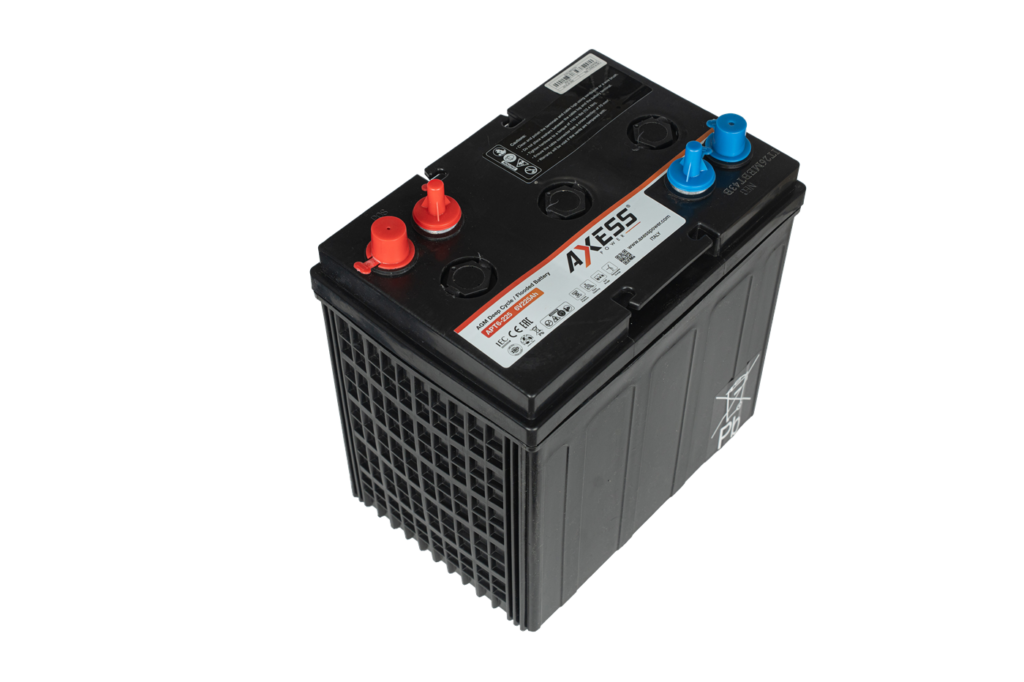
APT6-225 · 6V 225Ah deep cycle
Axess Power, supplied by AAGE International
36V–48V
Two-seater carts
60V–72V
Six-seater carts
4,000+
Deep-discharge cycles as a working baseline
10 years
The warranty floor buyers ask for
Reliable power for golf carts and utility vehicles
Hilly ground asks for more amperage. The pack has to hold a decent acceleration while it carries the load, and a lighter battery lets the buggy move more freely. Modern carts add Bluetooth and LCD screens, which only stay honest if the voltage stays steady. Waterproofing matters as much as weight.
The same judgement shows up on heavier duty: forklifts on long shifts, aerial lifts that have to stay in balance, utility vehicles that work for hours. Those jobs are only settled properly when the supplier already understands them. That is the work AAGE International does.
Complete golf cart battery solutions from AAGE International
Choose lithium-iron when the output matters more than the invoice. Choose lead-acid when the upfront saving matters, and budget for the maintenance that comes with it.
Lithium-iron
Maintenance-free, charged in a couple of hours, and still full when it has been sitting. Output stays steady, and the weight barely changes how the buggy feels. Life runs up to 15,000 cycles. About 95% of the charge can actually be used. The cost is paid at the start.
Lead-acid
The lower entry price, with life up to 7,000 cycles. Charging takes 6 to 12 hours, storage needs a float charge, and terminals need cleaning. Output drops as the pack drains, and the weight sits on the buggy. About 80% of the charge is usable before thermal runaway becomes the limit. It needs a maintenance routine.
Lithium-iron and lead-acid, side by side
| Feature | Lithium-iron | Lead-acid |
|---|---|---|
| Life span | Up to 15,000 cycles | Up to 7,000 cycles |
| Maintenance | Maintenance-free | Routine maintenance |
| Charging time | Faster — a couple of hours | 6 to 12 hours |
| Storage | Stays fully charged | Needs a float charge |
| Spillage | No acid issues | Terminals need regular cleaning |
| Weight | Negligible effect on the buggy | Weighs the buggy down |
| Cost | Higher upfront | Lower to buy |
| Consistency | Steady output | Falls away as the battery drains |
Figures describe the two chemistries clubs compare when specifying a golf buggy battery. Deep-cycle duty, with 4,000-plus cycles and at least a 10-year warranty, is the baseline buyers already expect.
A one-stop supplier is worth more than a price list. AAGE International’s experience is what gets a club to the battery that is actually profitable to run. Lithium-iron suits most golf buggy specs because 95% of the charge is usable, against about 80% for lead-acid. Deep-cycle batteries fit this duty: the output does not keep breaking off. AGM deep-cycle is the golf-cart favourite for a reason — no watering routine, and a safer case. Utility-vehicle packs are built to hold a high load for a long time, and they should be bought from a supplier that specifies them that way.
95%
of a lithium-iron charge can be used
80%
of a lead-acid charge, before thermal runaway
Where our golf cart batteries deliver
They are quiet and they do not smoke. That is why they show up in premium recreation, and why the same carts now carry guests, residents, and passengers.
Golf courses
Steep inclines, constant stops, and thick grass. This is where the pack has to prove it.
Resorts and hotels
Buggies kept ready so a guest can move the moment they need to.
Tourism and hospitality
A quiet, zero-exhaust way to move guests, including senior visitors.
Residential communities
LSV permits for neighbourhood trips, shopping, and visits inside the gates.
Facility management
Carts used as a working service across large sites, not as a novelty.
Airports
Passenger moves between terminals and stands, where uptime is the whole job.
Key benefits of a high-performance golf cart battery
Hill work, still in control
Surprising pull on rising ground, with acceleration that stays predictable.
A longer day
Runtime and driving range stretch past what an ordinary light-vehicle pack will give.
Less workshop time
Lower maintenance is what makes the price bearable after the invoice is paid.
A service life that earns it back
The pack stays in service long enough for the investment to return.
Deep-cycle duty
Built to work for long periods without the usual worry of internal damage.
Efficiency the fleet can feel
Reliable chemistry and better energy use, which is why operators specify them.
Battery technologies for golf cart applications
The deep-cycle conversation has moved. Lithium iron phosphate leads it. AGM is the practical step next to it. Both take vibration and temperature. The difference is maintenance, weight, and how much of the new monitoring — BMS, Bluetooth, LCD — you want on the cart.
Lithium iron phosphate
Life, weight, and efficiency that come close to doubling the rest of the field. A built-in BMS can put the state of charge on a live display, with Bluetooth and an LCD when the cart is specified that way. This is the maintenance-free end of the range.
AGM deep cycle
Slightly heavier, slightly less to buy, and about 80% of what a LiFePO4 pack delivers. It is still the battery many fleets know how to charge, install, and keep. APT6-225, a 6V 225Ah Axess Power deep-cycle battery, is one of the units in this family.
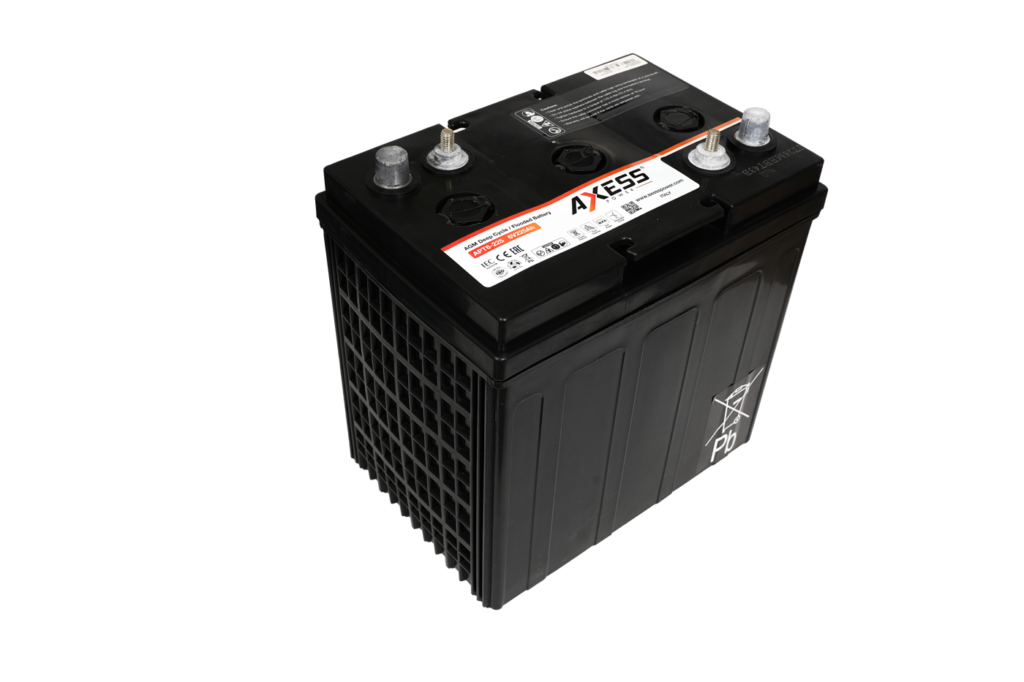
The Axess Power deep-cycle range
European brand Axess Power, supplied by AAGE International. The cases below are deep-cycle golf cart batteries — vent-cap and stud-terminal builds — photographed for specification, not as lifestyle props. Tell us the cart voltage and we will match the series.
APT6-225 is marked on the case as 6V 225Ah. The other photographs are Axess Power deep-cycle batteries from the same range. Share the cart voltage and we will match the model.
Why businesses in Qatar trust AAGE International
In a trade that keeps changing, trust is the part you cannot print on a label. AAGE International is built around that: local rules and global standards, followed as procedure rather than as a slogan, and a supply position that clubs and contractors across the GCC already use.
Axess Power is the European brand beside that supply. The range, and the applications it covers, is why the company is treated as a battery house rather than a reseller. AAGE International exhibited with BNI in the pavilion at Project Qatar. Distribution, long warranties, and after-sales support are what make the relationship last past the delivery.
Quality assurance, technical guidance and after-sales support
Quality assurance
A reputed supplier is certified, and the certificates are backed by a test procedure. AAGE International keeps that process in place so the battery that arrives is the battery that was specified.
Technical guidance
Voltage, the right model for the terrain, and whether the cart needs a monitoring display are decided with you, so the ride feels settled. Charger compatibility is part of that conversation, not an afterthought.
After-sales support
Warranty, installation, maintenance, and spare supply only matter if the supplier is still there. Years of battery supply sit behind the team that helps operators get a better result at a sensible running cost.
Tell us the cart, the voltage, and where it has to work. AAGE International will recommend the battery and reach you quickly.